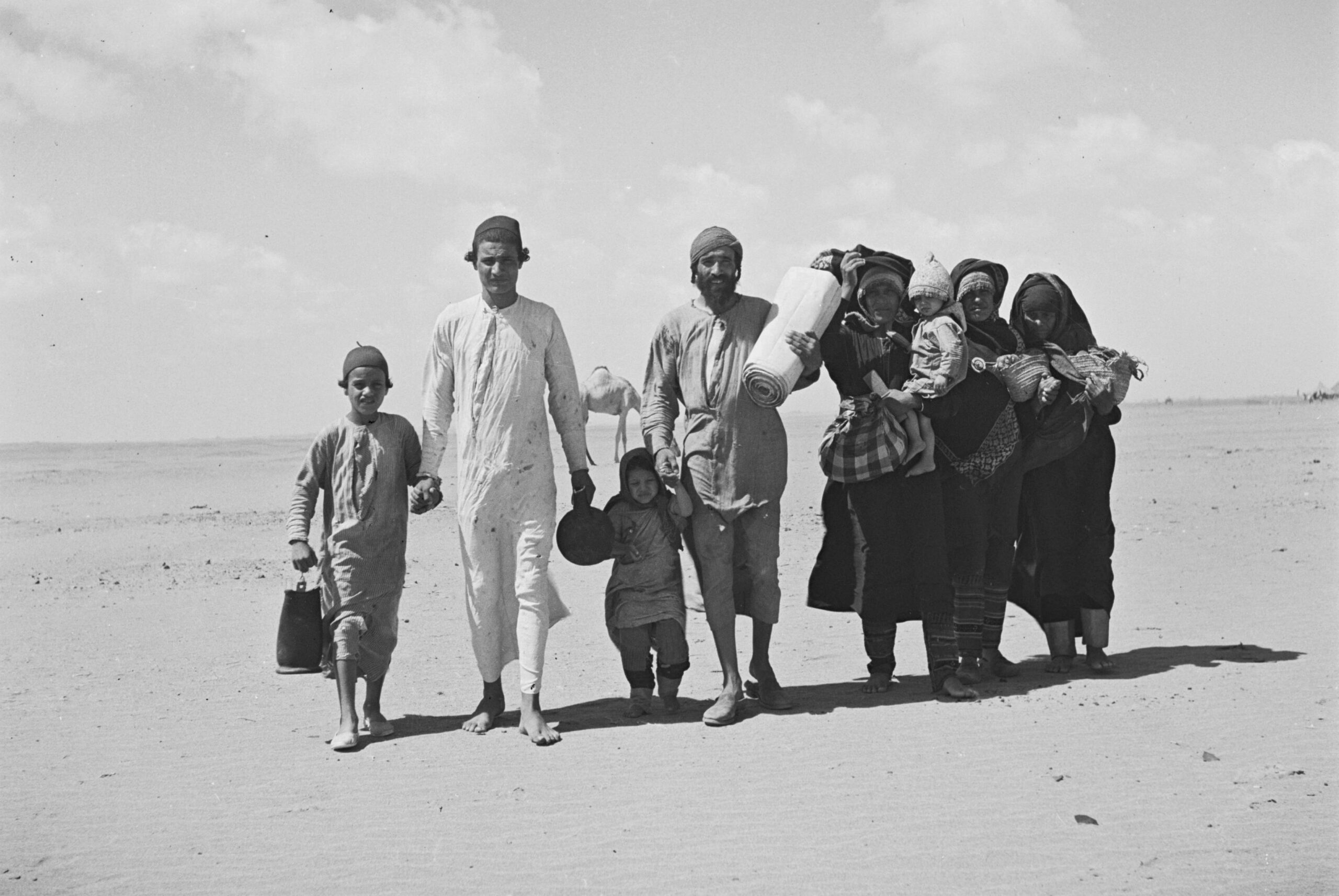
World empires like Assyria, Babylonia, and the Roman Empire exiled Israel’s population from their homeland but failed to wipe out their connection with the land and the people.
Today there are several theories as to where Israel’s ten lost tribes ended up.
The Assyrian conquest of the Kingdom of Israel more than 700 years before the birth of Jesus led to ten of Israel’s tribes being driven away to Assyria. The Kingdom of Israel had split about 200 years earlier into two kingdoms: the northern Kingdom of Israel and the southern Kingdom of Judah.
Many civilians were killed during Assyria’s invasion of the northern kingdom, although not all were exiled. Some of the population fled to the Kingdom of Judah, and those who remained eventually became known as Samaritans, named after the capital Samaria. The Bible describes, for example, how King Hezekiah, who reigned approximately 715–686 BCE, invited inhabitants of the northern kingdom to celebrate Passover in Jerusalem with the Jewish population.
The exile to Assyria meant that entire tribes disappeared. The tribes of Reuben, Gad, Dan, and Naphtali are never mentioned again, and archaeological finds from these regions show that a large depopulation process took place at this time.
Unlike the Kingdom of Judah, which was allowed to return from its Babylonian captivity, the ten tribes of the northern kingdom were never permitted to return and rebuild their homeland. Even today rabbis debate where those lost ten tribes went.
In 1 Chronicles chapter 9 there are accounts of which Israelites actually returned to Jerusalem: from the tribes of Judah, Benjamin, Levi (Levites and priests), as well as the tribes of Ephraim and Manasseh.
The Temple destroyed
The population of the Kingdom of Judah was deported to Babylonia from 587 BCE in three stages, the third of which saw the Babylonians completely destroy the Temple in Jerusalem. After the destruction of Jerusalem and the exile to Babylon, the Persian king Cyrus gave the banished Jews permission to return to Jerusalem and the land of Judah.
Daniel the prophet was among the first to be deported, and seven decades later Cyrus issued his decree that the Jews could return to Judah and rebuild their temple. Just over 42,000 Jews returned to Judah while a significant majority chose to remain in the Persian Empire, of which Babylon was now a part.
The returning Jews rebuilt the Temple in Jerusalem under the leadership of Zerubbabel; it was completed in 516 BC. Ezra and Nehemiah led further returns and the rebuilding of the walls of Jerusalem.
The Second Temple was initially not nearly as impressive as Solomon’s had once been, but king Herod the Great had the Temple and the Temple Mount expanded in even greater splendour than Solomon’s between 19 and 9 BC. The Temple enjoyed a new heyday until 64 AD.
Second Temple also destroyed
During the first Judeo-Roman War (66–73 AD), the Roman army under Titus besieged Jerusalem. The army eventually broke through the city walls and destroyed the Second Temple. The destruction and loss of life were disastrous, however many Jews remained in Judea. Tens of thousands were killed. Josephus estimated that 97,000 were enslaved and others were driven out.
After the Bar Kokhba revolt (132–135 AD), Emperor Hadrian expelled the Jews from Judea and banned them from Jerusalem, causing the Jewish population to be scattered throughout the Roman Empire and beyond.
The revolt was crushed and led to a depopulation of Judea through mass murder, slavery, and expulsion of the Jewish population.
Hundreds of thousands were killed, the spiritual centre of Jewish life moved to Galilee and to the growing diaspora, and the divide between Judaism and early Christianity deepened.
Hundreds of thousands killed
The Roman historian Cassius Dio claims that 580,000 Jews were killed. Archaeological evidence suggests that many sites in Judea were damaged, destroyed, or abandoned, so that Jewish settlement in Judea was almost completely wiped out. The slave market was flooded with Jewish captives who were sold into slavery and dispersed throughout the empire, writes Menahem Mor in his book on the Bar Kokhba revolt.
The Romans depopulated villages, and farmland owned by Jews was confiscated. In an attempt to erase the memory of Judea and Israel, the province of Judea – whose name had a clear ethnic link to the Jews – was officially renamed Syria Palaestina, associated with the (then extinct) Philistines, Israel’s historical enemies. After the revolt, the Hebrew language largely disappeared from everyday use.
Although the Jewish presence in the region declined dramatically, a smaller but continuous Jewish population remained. In the following centuries Galilee became an important centre of Jewish leadership and culture. In the diaspora, the dream of Zion – returning to the promised land – was kept alive for centuries.
The early church was infected by the Roman Empire’s antisemitism, which became the breeding ground for replacement theology, which in turn paved the way for Europe’s persecutions of Jews. During the second half of the 19th century, Zionism grew among Jews in Europe with the goal of creating an independent Jewish state to protect the Jewish people from persecution.
Claims of possible ethnic connections between several older Jewish diaspora communities in Asia, Africa, and the Middle East have been made, for example regarding the Lemba people in southern Africa, Bene Israel, Bene Ephraim, and Bnei Menashe in India, Kurdish Jews, Pashtuns in Afghanistan, Assyrian Jews, and Beta Israel in Ethiopia.