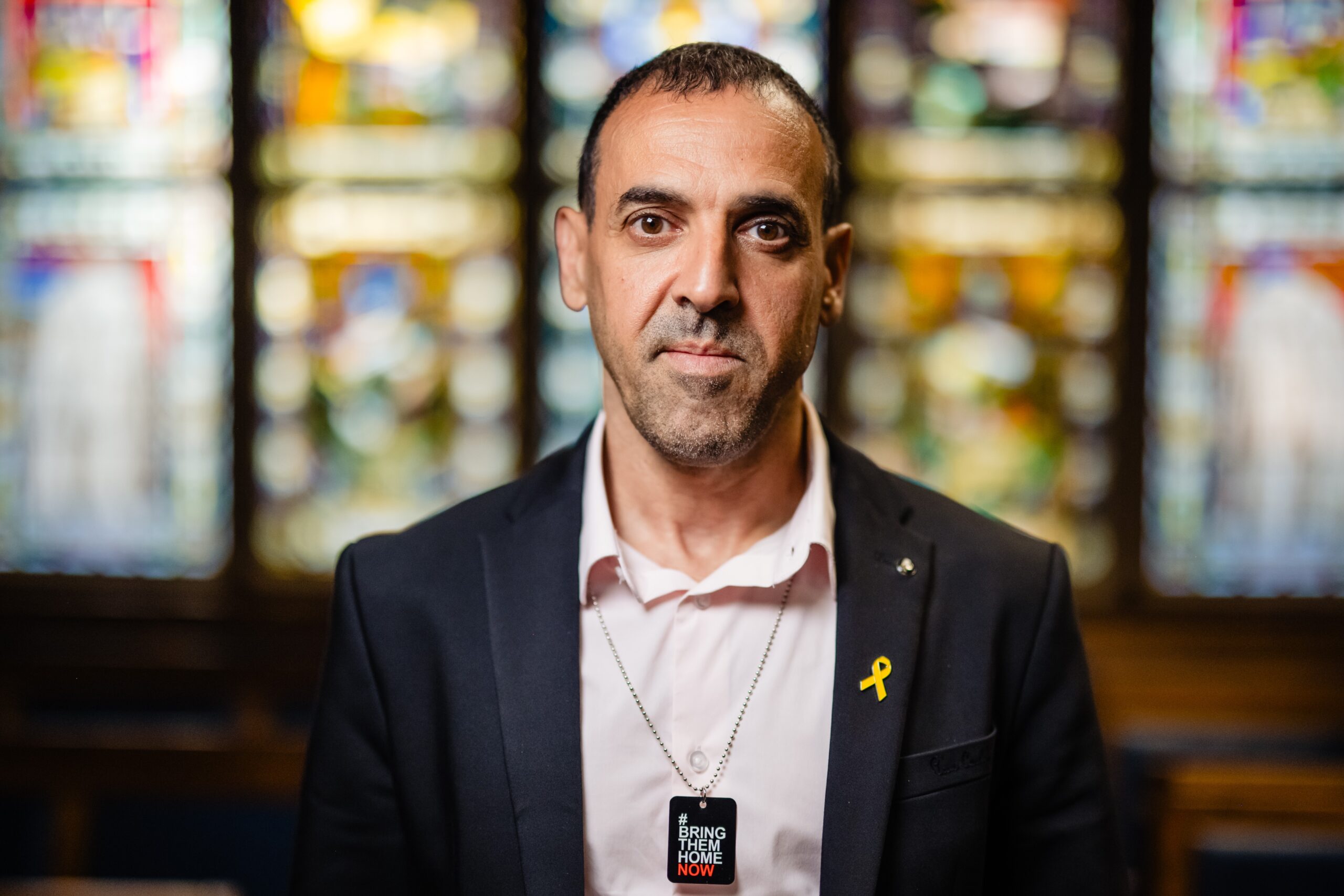
When Eli Sharabi fought for his life in Hamas tunnels, he carried a legacy of survival. Sharabi has Yemeni and Moroccan roots, and like millions of other Israelis, memories of persecution are not distant historical chapters but stories that have lived on around kitchen tables, in family albums and in the silence of relatives who did not survive.
In Eli Sharabi’s family, memories stretch back to Yemen, where one of the world’s oldest Jewish communities lived for almost two thousand years. But during the 20th century, life became increasingly dangerous. Discrimination, violence and religious persecution were part of everyday life. When the UN adopted the partition plan for Palestine in 1947, hatred exploded.
In the port city of Aden, mobs roamed the streets. Jewish homes were set on fire. Shops were looted. Synagogues were destroyed. People were hunted and killed. At least 80 Jews were murdered and hundreds were injured.
For many, the only option was to flee.
Families left everything they owned and walked hundreds of kilometers through desert landscapes to temporary camps in Aden. This was followed by one of the most dramatic rescue operations in modern Jewish history. Between 1949 and 1950, almost the entire Jewish population of Yemen – some 50,000 people – was flown to Israel.
Those who remained lived under constant threat. Generations later, the Iran-backed Houthi movement would complete what the persecution had begun. In 2021, the last remaining Jewish families were forced to leave the country. A Jewish community that had been around for almost two thousand years had been virtually wiped out.
His parents also have a different story of escape. When the Jews were driven out of Spain and Portugal during the Inquisition, many found refuge in Morocco. Jewish communities flourished there for centuries. At the time of Israel’s independence in 1948, over a quarter of a million Jews lived in the country.
But even there, everything changed.
When the war against the newly formed state of Israel broke out, violence spread. Pogroms shook cities like Oujda and Jerada. Jewish families began to understand that their future no longer lay where their ancestors had lived for generations. In the following decades, almost all of Moroccan Jewry left the country.
Sharabi’s family story is far from unique. On the contrary, it reflects the population of Israel as a whole.
Between 1948 and the early 1970s, some 850,000 Jews fled Arab countries and Iran. Most sought refuge in Israel. Today, several million Israeli Jews have a parent, grandparent or other close relative who was forced to leave their home in the Middle East or North Africa.
But the story of flight and persecution does not begin there. For many Israeli families, the family tree goes back to the bloody 19th and 20th centuries in Europe.
In the decades before World War I, waves of anti-Jewish pogroms swept through the Russian Empire. Jewish villages and neighborhoods were attacked. Homes were looted. Women were raped. Families were murdered. Millions of people fled the violence and poverty.
Many made their way to what would later become the state of Israel. Others sought refuge further west in Europe.
There, the next catastrophe awaited.
For many families, fleeing the pogroms was only a respite before the Holocaust swept across the continent. Relatives who had escaped Tsarist Russia ended up in Nazi ghettos, labor camps, and death camps a few decades later.
That is why the Holocaust is still present in countless Israeli families.
Hundreds of thousands of survivors built new lives in Israel after World War II. They had children, grandchildren, and great-grandchildren. At the same time, millions of Israelis carry the memory of relatives who never returned from Auschwitz, Treblinka, Sobibór, and the other death camps.
In today’s Israel, it is therefore difficult to separate the history of the nation from the history of their families.
For millions of people, the memory of the Holocaust, the Russian pogroms, and the flight from the Arab world are not abstract historical events. They have names, faces, and family ties.
A grandfather who survived Auschwitz. A grandmother who fled Yemen. A grandfather who escaped the pogroms in Ukraine. A grandmother who left Morocco with only a suitcase.
Many Israeli families carry several of these stories at once.
And when Eli Sharabi sat chained in the darkness under Gaza, he was not just a lone hostage fighting for his life. He was also the heir to generations of people who have been faced with the same question over and over again: How do you survive when everything around you is trying to crush you?